
We currently have over 65 awardees, each loaning an instrument from the Cherubim Trust. We celebrate our awardees’ musical journey and achievements through regular news items, and by highlighting individuals in our new Awardee Spotlight.
Awardee Spotlight: Alexia Pasquariello

From discovering the flute as a child in Romania to building a musical career in London, Cherubim awardee Alexia Pasquariello shares her journey, ambitions and the impact of playing the Trust’s ‘Deborah Steer’ Muramatsu flute
What first inspired you to take up the flute, and how did your passion for music develop?
My love for the flute began when I was ten years old. From an early age, I would watch classical music channels such as Mezzo and the flute always seemed to capture my imagination. I still remember the first flute solo that truly captivated me: Mendelssohn’s music for “A Midsummer Night’s Dream”. I would imagine the different landscapes and scenes that might have inspired the music, and later became fascinated by discovering the stories behind the works I listened to.
Another defining moment was discovering James Galway’s playing. His sound and musical expression left a lasting impression on me and ultimately inspired me to take up the flute myself. What began as a fascination with the instrument’s beautiful sound gradually grew into a lifelong passion for music.
What brought you from Romania to London to pursue your musical studies? How has studying at the Royal Academy of Music shaped you as a musician?
I always knew I wanted to become an international musician. My passion for discovering new cultures, travelling and bringing people together through music has always been an important part of that ambition. I first visited London as a tourist when I was sixteen, and by the end of the trip, I had a strong feeling that I belonged here. I promised myself I would return and a few years later, that dream became a reality when I began my studies at the Royal Academy of Music.
Studying at the Academy was a turning point in my musical development. Working with outstanding musicians and professionals in the industry helped me deepen my musical understanding, refine my artistry and grow in confidence as a performer. It became the first stepping stone towards building an international career, therefore the Academy will always hold a very special place in my heart.
You play on the Muramatsu ‘Deborah Steer’ Platinum Flute. What difference has having access to this instrument made to your playing and musical development?
The Muramatsu ‘Deborah Steer’ Platinum Flute has made a tremendous difference to my musical journey. I received it at a time when I felt I had outgrown my previous instrument and was ready for a new one that could support my artistic development. From the moment I played it, it felt like a perfect fit for me, with a rich, deep sound that also has a beautiful brightness and clarity.
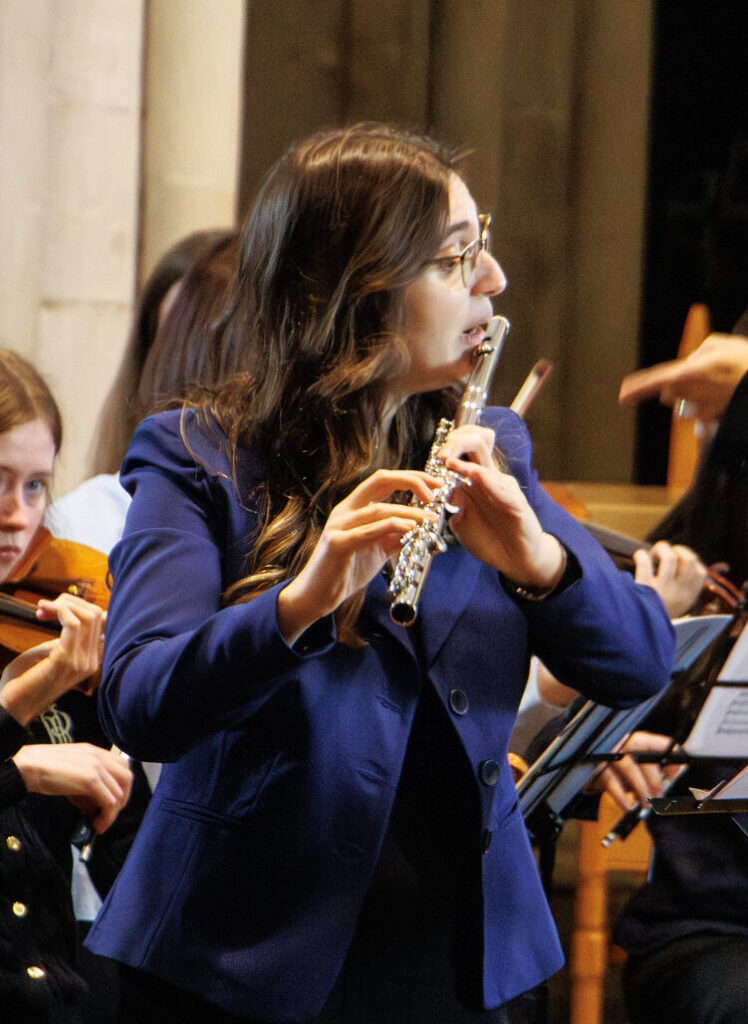
Beyond its musical qualities, the flute holds a very special emotional significance for me, as it was named after Deborah Steer, who is very dear to me. Having the opportunity to play such a wonderful instrument has been invaluable, both artistically and personally, and I am incredibly grateful to Cherubim Music Trust for making this possible.
“From the moment I played it, it felt like a perfect fit for me, with a rich, deep sound that also has a beautiful brightness and clarity.”
You’ve recently completed your studies at the Royal Academy of Music. What have been some of the most memorable or rewarding experiences from your time there?
One of my most memorable experiences at the Royal Academy of Music was performing Bruckner’s Seventh Symphony under Ryan Wigglesworth. His attention to detail and the depth of his musical insight were hugely inspiring and the experience taught me so much about the importance of listening, collaboration and bringing a score to life.
Throughout my studies, I also took part in several musical theatre productions, including “The Last 25 Years of West End”. These experiences deepened my love for musical theatre and for the magic that happens when music meets visual storytelling. This continues to inspire the concerts I curate today and was one of the reasons I was drawn to Sinfonia Smith Square, whose innovative programming explores exciting ways of bringing music together with other artistic elements.
Above all, my time at the Academy was shaped by the people I met and learned from. I feel incredibly fortunate to have worked with inspiring flute teachers, particularly Karen Jones, Katherine Baker, Paul Edmund-Davies, Silvia Careddu and Carla Rees, all of whom have contributed in different ways to my musical development and artistic identity.
You’ve performed in a variety of settings, from orchestral concerts to chamber music with the Etérea Duo. What do you particularly enjoy about making music with others?
For me, one of the most beautiful aspects of music is the opportunity to share it with others. I love exchanging musical ideas and discovering how each musician brings their own perspective and personality to a piece. The more people come together, the richer the artistic conversation becomes, allowing the music to grow into something greater than any one individual could create alone.

Making music collaboratively is my way of connecting with others and contributing to something bigger than myself. That shared experience is one of the things that makes performing so meaningful to me.
Congratulations on joining the woodwind section of Sinfonia Smith Square for the 2026/27 season! What are you most looking forward to about this next chapter?
I am most looking forward to being challenged musically, learning from the people around me and sharing my passion for music with my colleagues. I am particularly excited by the breadth and creativity of Sinfonia Smith Square’s programming, which brings music together with different artistic elements to create fresh and engaging experiences. I love exploring new ways of presenting classical music and connecting with audiences, so I am really looking forward to being part of an orchestra that embraces this spirit of curiosity and innovation.
What have been some of your proudest musical achievements so far? Is there a particular performance or experience that stands out?
I feel incredibly fortunate to have had opportunities to win competitions, take part in exciting projects at the Royal Academy of Music, join Sinfonia Smith Square and perform in orchestral concerts and tours. However, if I had to choose my proudest achievement, it would simply be bringing a smile to someone’s face through music.
For me, the true measure of a performance is the impact it leaves on people. This is also why I regularly take part in charity concerts: I believe music has the power to bring people together, offer comfort and make a genuine difference in the world. Ultimately, if someone leaves a concert feeling happier or more connected to others, I feel I have achieved something meaningful.
Looking ahead, what are your musical ambitions? Are there any particular pieces, collaborations or opportunities you’re especially excited about?
I am looking forward to a very fulfilling year ahead, with a wide range of orchestral and chamber music concerts, masterclasses, workshops, educational projects and tours through Sinfonia Smith Square. I am particularly excited about future collaborations with orchestras such as the Philharmonia Orchestra, the Royal Scottish National Orchestra, the Academy of St Martin in the Fields and Aurora Orchestra.

Alongside orchestral work, I am keen to continue developing exciting chamber music projects with Etérea Duo. I love exploring different ways of sharing music with audiences, and I hope to keep challenging myself artistically while creating meaningful musical experiences for others.
If you could perform any piece of music, anywhere in the world, what would you choose and why?
One of my favourite pieces is Aaron Copland’s Appalachian Spring. The title comes from a line of poetry, and I love that it isn’t really about a place on the map or simply a season, but evokes the idea of a spring as a source: something life-giving, fresh and quietly hopeful. That idea of new beginnings resonates deeply with me as someone who moved from Romania to the UK to follow a dream and build a new home through music.
So much of this piece’s beauty lies in its transparency, the listening and blending between instruments and the way a musical line passes so naturally from one voice to another. As a musician, I love how it asks the entire ensemble to breathe together, listen to one another and tell a single story. It is a beautiful reminder of how individual voices can come together to create something that feels whole and deeply human.
What advice would you give to a young musician hoping to pursue a career in classical music?
Become a musician out of a genuine desire to elevate music and do it justice, rather than for the sake of recognition or fame. Let music be a source of happiness and a lifelong journey of discovery, one that constantly challenges you to learn, grow and improve. There will always be more to explore, understand and share, and I believe that approaching music with curiosity, humility and a sense of purpose is what makes the journey truly rewarding.
Proudly powered by WordPress